


Hall Automotive: This Week in 1926 October 16–22, 1926 – When Entertainment Meant Seeing the Impossible in Person
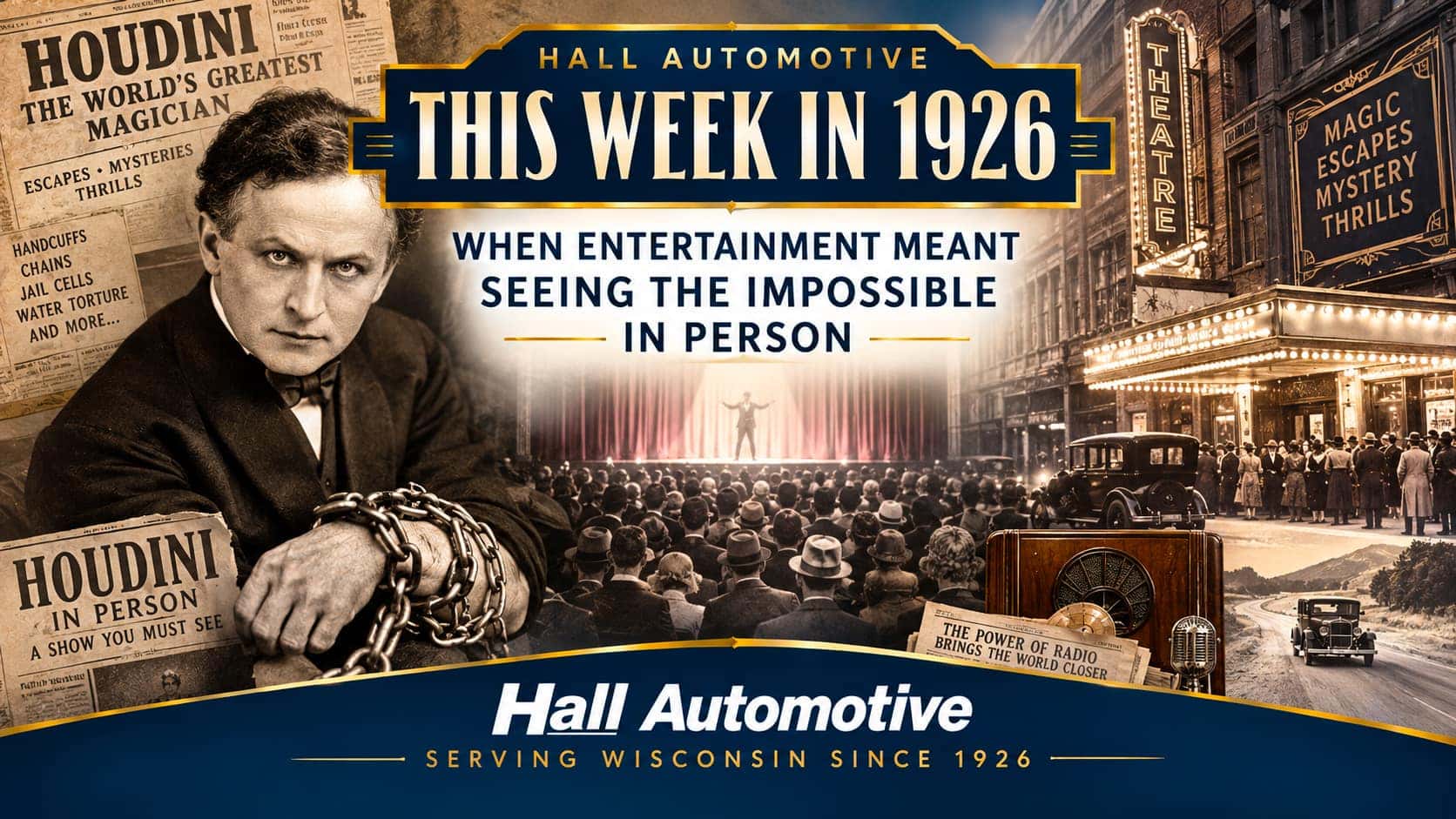
Imagine entertainment before television. Before streaming. Before YouTube. Before social media. If you wanted to see one of the world’s greatest entertainers in 1926, there was a good chance you had to travel to a theater and see that person yourself. And few performers in the world were more famous than Harry Houdini.
The Man Who Could Escape Anything
By 1926, Houdini was internationally famous. He had escaped from handcuffs, chains, locked boxes, jail cells, and his famous water torture cell. Audiences knew his name. Newspapers followed his exploits. His ability to promote himself was almost as remarkable as his ability to escape. Houdini had essentially built a worldwide personal brand decades before anyone used that terminology. In October 1926, he was still touring. But his performances had evolved. His shows included magic and escapes, but Houdini had also become an outspoken critic of fraudulent spiritualists and mediums. Part of his stage presentation exposed techniques he believed were being used to convince grieving people that performers could communicate with the dead.
October 1926: Montreal
During October, Houdini traveled to Montreal. While there, events occurred that would become inseparable from the legend surrounding his death. On October 22, a McGill University student visited Houdini and reportedly asked about the magician’s famous ability to withstand blows to the abdomen. The student struck him several times before Houdini had fully prepared himself. For decades, popular retellings suggested those blows caused Houdini’s appendix to rupture. Modern historical and medical interpretations are more cautious. Houdini was suffering from appendicitis, and whether the punches caused, aggravated, or were simply coincidental to the condition remains uncertain.
What is known is that Houdini was in significant pain.
And he continued performing.
Entertainment Before the Digital Age
Houdini’s enormous fame also tells us something about America in 1926. Entertainment was becoming a national business. Radio could carry voices across the country. Motion pictures could turn actors into celebrities. Newspapers could make athletes and performers household names. And the automobile allowed audiences to travel farther to see performances, sporting events and movies. Americans had more leisure time, greater mobility and an expanding number of ways to spend both. Modern popular culture was beginning to take shape.
The Journey Continues
Despite his worsening condition, Houdini continued his schedule. His next major destination was Detroit. He was booked at the Garrick Theatre. He intended to perform. What happened next would turn the final week of October 1926 into one of the most famous chapters in entertainment history.
We’ll finish that story next week.
Hall Automotive – Serving Wisconsin Since 1926
0 comment(s) so far on Hall Automotive: This Week in 1926 October 16–22, 1926 – When Entertainment Meant Seeing the Impossible in Person