


Hall Automotive: This Week in 1926-August 20, 2026 – When America Began Asking: How Do We Make Driving Safer?
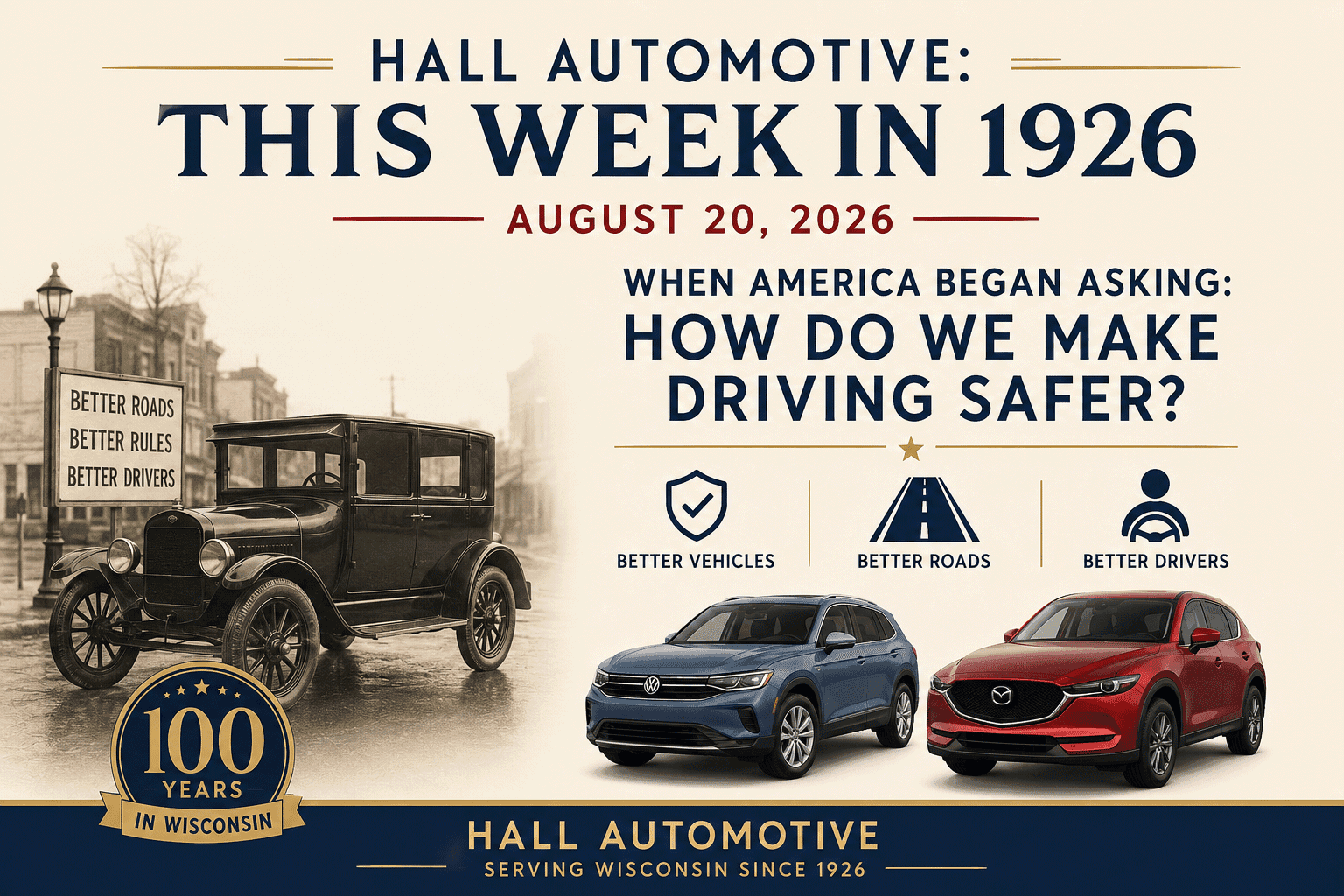
As Hall Automotive celebrates 100 years in Wisconsin, we’re looking back at the issues that mattered to American motorists during the same time in which Hall’s Wisconsin story began with a Chevrolet dealership in 1926.
More Cars Created a New American Challenge
By the summer of 1926, Americans had embraced the automobile. Millions of vehicles were sharing roads that, in many communities, had originally been designed for horses, wagons, and pedestrians.
That created an entirely new problem: How do you make automobile travel safer?
It was becoming an important enough subject that the August 1926 edition of Scientific American included an article devoted to analyzing America’s automobile accident problem. Even newspapers were asking questions that sound surprisingly modern.
During the first week of August 1926, one newspaper’s public-opinion feature asked whether motorists should be required to pass vision and hearing tests before receiving a driver’s license.
The automobile had become so popular that society was beginning to realize something important: Building better cars wasn’t enough. America also needed better roads, better traffic rules, and better-trained drivers.
Driving Was Very Different 100 Years Ago
Modern drivers benefit from safety technology that simply didn’t exist in 1926.
There were no backup cameras. No blind-spot monitoring. No automatic emergency braking. No lane-departure warnings. No airbags. And the modern three-point seat belt was still decades away.
Road infrastructure was also far less sophisticated. Traffic signals, lane markings, signs, and standardized highway systems were all still developing. Driving demanded constant attention—and mistakes could have serious consequences.
The Automobile Industry Responds
Over the following century, safety would become one of the automobile industry’s greatest areas of innovation. Manufacturers continually improved braking systems, lighting, tires, vehicle construction, and occupant protection.
Eventually came seat belts, crumple zones, and airbags. Then came electronic stability control and anti-lock brakes.
Today we have cameras, radar and computer systems capable of detecting hazards before a driver may even recognize them.
Modern Mazda and Volkswagen vehicles can provide drivers with an extraordinary collection of technologies designed around one basic objective: Help people reach their destination safely.
The Question Hasn’t Changed
Technology has transformed the automobile almost beyond recognition since 1926. But the challenge being discussed 100 years ago remains with us.
How do we make driving safer? The answers continue to evolve. Better vehicles. Better roads. Better driver education. And increasingly, better technology.
When Hall’s first Wisconsin customers climbed behind the wheel of their Chevrolets in 1926, automobile safety was only beginning to become a national conversation.
A century later, that conversation continues every time a new generation of vehicle technology reaches the road.
Hall Automotive – Serving Wisconsin Since 1926
0 comment(s) so far on Hall Automotive: This Week in 1926-August 20, 2026 – When America Began Asking: How Do We Make Driving Safer?