


Hall Automotive: September 1926 – America Was Changing Fast
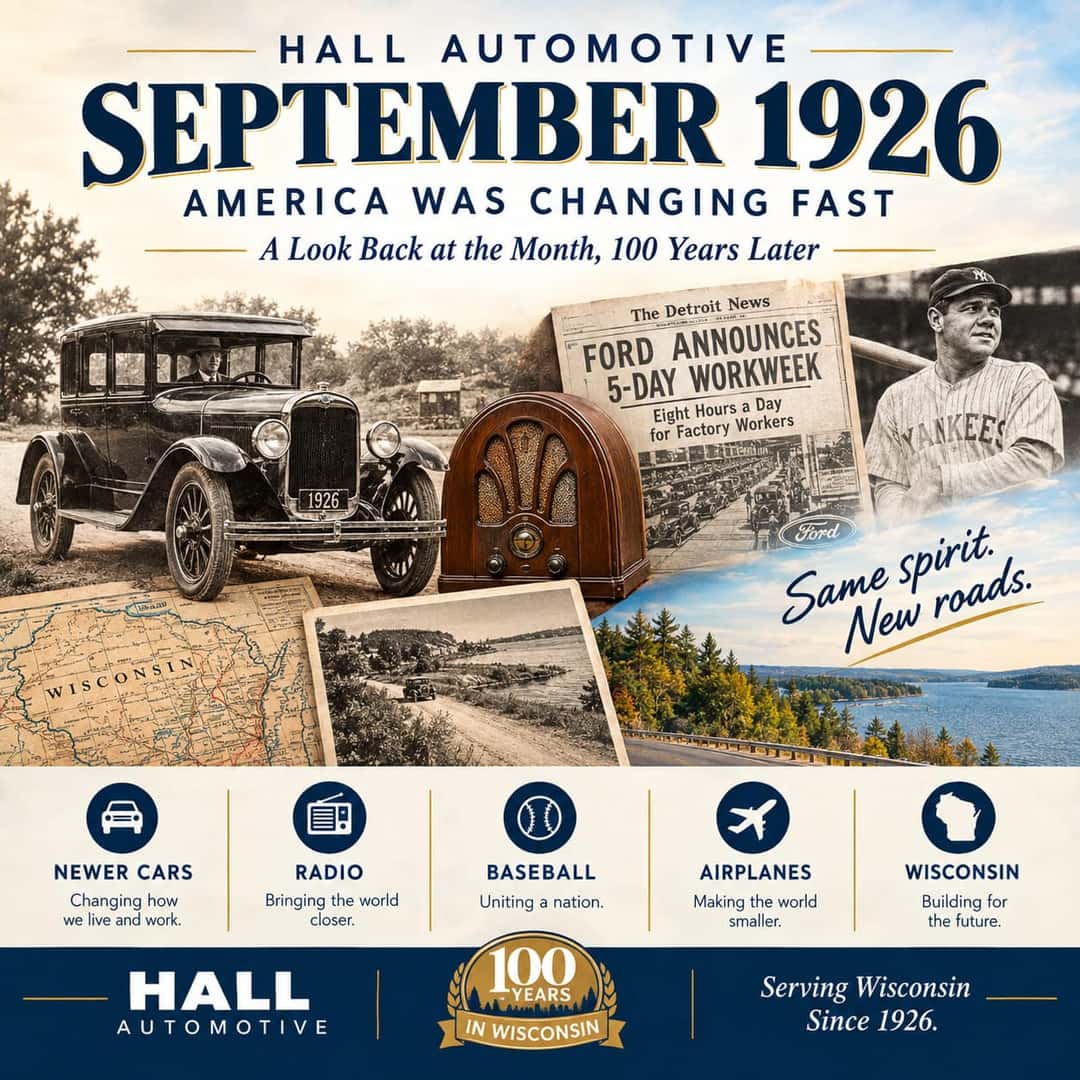
A Look Back at the Month, 100 Years Later
As Hall Automotive celebrates 100 years in Wisconsin, we’ve been looking back at the world our company was born into—one week at a time.
We missed September. So rather than skip over it, we’re going to do something a little different.
Let’s go back 100 years and spend some time in September 1926, a month that provides a fascinating snapshot of an America in transition. Cars were changing where people could live and work. Radio was changing how quickly information traveled. Professional sports were becoming a national obsession. Airplanes were beginning to make the world feel smaller. And one of America’s largest automakers was about to make a decision that would permanently change the American workweek.
Meanwhile, here in Wisconsin, Hall was beginning a journey of its own.
Imagine Wisconsin in September 1926
There were no interstate highways. No television. No commercial passenger airline system resembling what we know today. No smartphones, computers, or internet. Many Wisconsin roads outside populated areas remained unpaved, and horses and automobiles could still be found sharing the road.
But change was everywhere. The automobile was moving from novelty to necessity. Radio sets were becoming fixtures in American homes. Cities were expanding outward as workers discovered they no longer had to live within walking distance of their jobs. America was becoming more mobile. And that mobility was beginning to reshape everyday life.
Ford Helps Create the Modern Weekend
One of the most significant changes came near the end of the month. On September 25, 1926, Ford Motor Company completed its move to an eight-hour, five-day workweek for factory employees, eliminating regular Saturday work. Think about how significant that was. The six-day workweek had long been normal for American workers. Suddenly, thousands of employees had something relatively new: two consecutive days away from work.
Ford’s decision wasn’t purely altruistic. Henry Ford understood that workers needed time away from the factory—and that leisure time also created consumers.
People with free time traveled. They shopped. They visited family. They went fishing. They attended sporting events. And increasingly, they did those things in automobiles. The modern American weekend and the automobile grew up together.
Today we think nothing of getting into the car on Saturday morning and heading to a soccer game, a restaurant, a lake, a shopping center, or another city.
A century ago, Americans were just beginning to discover what two days of freedom—and a car in the driveway—could mean.
Baseball Captures America’s Attention
While American industry was changing, baseball was providing the entertainment. September 1926 brought the regular baseball season toward a dramatic conclusion.
On September 25, the same day Ford’s five-day schedule took effect, the New York Yankees clinched the American League pennant with a doubleheader sweep of the St. Louis Browns. Waiting for them would be the St. Louis Cardinals. For St. Louis, it was historic. The Cardinals were headed to their first World Series. And the Yankees had someone named Babe Ruth. By the end of September, excitement surrounding the upcoming World Series had spread far beyond New York and St. Louis. Newspapers around the country were preparing extensive coverage. Radio would allow Americans hundreds of miles from either ballpark to experience the games almost as they happened.
For a country only beginning to become electronically connected, that was extraordinary. The stage was set for one of the most memorable World Series ever played.
We’ll come back to that in October.
Wisconsin Was Looking Back Even as It Moved Forward
There’s an interesting piece of Wisconsin history from September 1926 that feels especially appropriate for Hall’s 100th anniversary. That month, the Wisconsin Historical Society published Volume 10, Number 1 of the Wisconsin Magazine of History. Its subjects included Wisconsin’s Swiss cheese industry, the invention of the twine binder, the home of Civil War governor Louis P. Harvey, and Milwaukee’s early architects. Even in 1926, Wisconsinites were looking backward and documenting how much their state had changed.
Now we’re doing the same thing—another century later.
Think about that perspective. People living in 1926 were preserving stories from Wisconsin’s earlier generations.
Today, 1926 itself is history. The automobiles they considered modern are museum pieces. The buildings they considered new are historic landmarks. And businesses established during that era are celebrating centennials. Hall is one of them.
America Was Learning to Think in Miles Instead of Blocks
Perhaps the biggest change of all wasn’t a particular invention or event. It was the way Americans were beginning to think about distance. Before widespread automobile ownership, where you lived strongly influenced where you worked, shopped, and socialized. A few miles could represent a significant journey. The automobile changed the equation. A neighboring community was suddenly closer. A job farther from home became practical. A Sunday visit to relatives didn’t necessarily require an overnight stay. A family could decide to go somewhere simply because they wanted to. That freedom helped reshape America.
Businesses followed motorists. Gas stations appeared. Restaurants opened along heavily traveled roads. Tourist camps and roadside lodging developed. Eventually, shopping centers, suburbs, motels, drive-in restaurants, and thousands of other businesses built around a simple assumption:
Americans could get there by car.
What Would a Hall Customer Have Driven?
A customer visiting a Chevrolet dealership in 1926 would have encountered an automobile almost unimaginably simple by today’s standards.
There was no automatic climate control.
No power steering.
No touchscreen.
No backup camera.
No blind-spot monitor.
No radar cruise control.
No satellite navigation.
Safety glass, hydraulic brakes, automatic transmissions, widespread in-car radios, and countless other features motorists would eventually take for granted were either still developing or years away from becoming commonplace.
Yet to a driver in 1926, that Chevrolet represented cutting-edge personal transportation. It represented independence. That’s an important part of this centennial story. We tend to look at an old automobile and see what it didn’t have. The person buying it in 1926 saw everything it suddenly allowed them to do.
100 Years Later
September 1926 wasn’t defined by one single event. It was a month within an extraordinary period of transition. Americans were working differently. Traveling differently. Communicating differently. Spending their free time differently. And increasingly, the automobile connected all of it.
One hundred years later, another transformation is underway. Vehicles now contain cameras, radar systems and computers. Hybrid and electric powertrains are becoming increasingly familiar. Cars communicate with phones, receive software updates and help drivers avoid collisions. The technology would be incomprehensible to a motorist from 1926. The purpose wouldn’t be. People still need to get to work. They still visit family. They still take weekend trips. They still drive to ballgames. They still load the car for vacation. And they still appreciate the freedom that comes from deciding where they want to go—and going there.
In September 1926, Hall was at the beginning of that story. In September 2026, we’re fortunate enough to still be part of it.
100 years. Generations of Wisconsin drivers. And plenty of road still ahead.
Hall Automotive – Serving Wisconsin Since 1926
0 comment(s) so far on Hall Automotive: September 1926 – America Was Changing Fast